
Press Plate Solutions for Decorative Panel Lamination
HPL Short-Cycle Pressing Press Plate enables a high-efficiency lamination process that cuts pressing time significantly, while retaining stable panel quality and bonding strength. The solution boosts production speed, optimizes thermal performance and ensures uniform quality for mass HPL manufacturing.
Decorative Panel Manufacturing Process
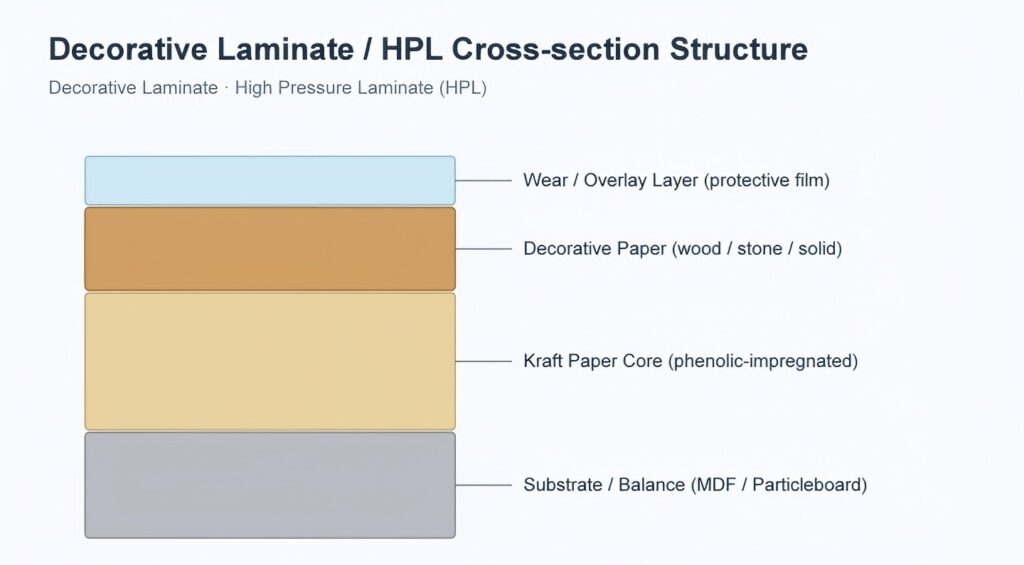
Decorative panel lamination is a process that bonds decorative papers or overlays onto substrates such as MDF, HDF, particleboard, or plywood using heat and pressure.
The typical production process includes:
- Decorative paper positioning
- Resin impregnation
- Hot pressing
- Surface texture transfer
- Cooling and stabilization
- Final quality inspection
Throughout this process, the press plate serves as the interface that transfers pressure, heat, and surface finish to the decorative panel.
Surface Appearance Requirements
High-quality decorative panels must deliver both visual appeal and consistent surface performance.
Critical appearance requirements include:
- Texture Reproduction
Wood grain, stone patterns, and embossed textures should be transferred with high fidelity and remain consistent across every panel.
- Gloss Uniformity
Uniform gloss creates a premium visual appearance without dull or overly reflective areas.
- Color Consistency
Stable pressing conditions help prevent localized color variation caused by uneven resin curing.
- Surface Smoothness
A smooth pressing surface minimizes imperfections while enhancing the overall decorative finish.
- Pattern Consistency
Decorative patterns should remain clear and continuous without distortion or texture loss.
Common Surface Appearance Challenges
Even small variations during lamination can significantly affect the final decorative effect.
| Surface Issue | Production Impact |
|---|---|
| Uneven gloss | Inconsistent visual appearance |
| Texture distortion | Reduced decorative realism |
| Surface pressure marks | Lower product grade |
| Orange peel effect | Poor surface finish |
| Resin-rich areas | Gloss inconsistency |
| Surface contamination | Cosmetic defects |
| Pattern inconsistency | Reduced product value |
These defects often require rework or panel rejection, increasing production costs and reducing manufacturing efficiency.
Root Cause Analysis
Most decorative surface defects originate from inconsistencies in surface transfer rather than the decorative paper itself.
Non-uniform Surface Contact
Uneven contact between the press plate and panel results in inconsistent texture replication.
Inconsistent Pressure Distribution
Localized pressure differences affect resin flow and surface finish.
Poor Press Plate Surface Finish
Surface imperfections on the press plate can be transferred directly onto decorative panels.
Surface Contamination
Dust, resin residue, or foreign particles may become embedded during pressing, creating visible defects.
Uneven Heat Distribution
Temperature variations can alter resin curing, affecting gloss and color consistency.
Surface Appearance Optimization
High-performance press plates help maintain outstanding decorative quality through optimized surface control.
- Mirror Surface Finish
Highly polished surfaces minimize transfer marks while improving decorative clarity.
- Accurate Texture Replication
Precision surface finishing faithfully reproduces embossed textures and natural wood grain patterns.
- Uniform Pressure Distribution
Balanced pressure ensures consistent resin flow and even decorative appearance across the entire panel.
- Stable Surface Temperature
Uniform heat transfer promotes consistent resin curing and color uniformity.
- Excellent Surface Cleanliness
Clean pressing surfaces reduce particle transfer and improve overall panel appearance.
Decorative Quality Improvements
Optimized press plates help manufacturers achieve measurable improvements in decorative surface quality.
| Quality Indicator | Conventional Process | Optimized Press Plate |
|---|---|---|
| Gloss Uniformity | Standard | Improved by 30–50% |
| Texture Reproduction Accuracy | Good | Excellent |
| Surface Defects | Baseline | Reduced by 40–60% |
| Decorative Consistency | Medium | High |
| Surface Contamination | Occasional | Significantly Reduced |
| First-Pass Yield | 93–95% | 97–99% |
Performance data represent typical industry improvements. Actual results depend on decorative paper type, resin formulation, press equipment, and production conditions.
Recommended Press Plate Characteristics
To achieve consistent decorative panel quality, press plates should provide:
| Press Plate Characteristic | Manufacturing Benefit |
|---|---|
| Mirror-polished surface | Superior gloss and clarity |
| Precision surface finishing | Accurate texture reproduction |
| Uniform heat transfer | Stable resin curing |
| High flatness | Consistent pressure distribution |
| Excellent wear resistance | Long-term surface consistency |
| Stable dimensional accuracy | Repeatable decorative quality |