
CCL Lamination Solutions for Temperature Uniformity
CCL Lamination Solution focuses on upgrading the manufacturing processes of copper clad laminates. It stabilizes overall board temperature uniformity, precision pressure control and material bonding performance, eliminating common defects such as copper foil wrinkling, delamination and resin voids during high-temperature lamination.
CCL Manufacturing Overview
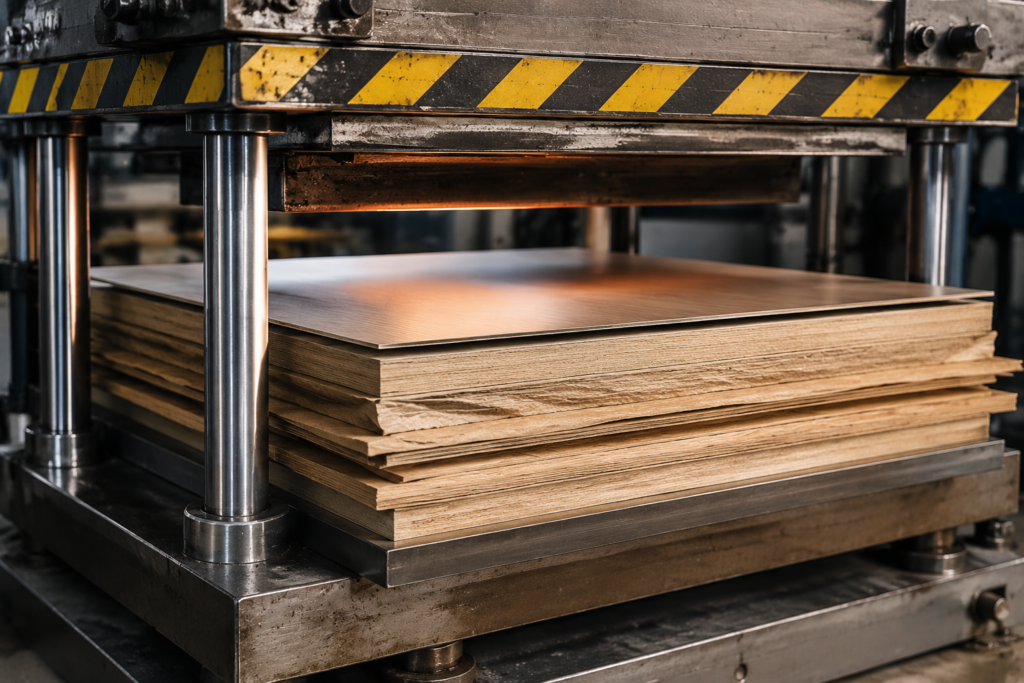
The CCL lamination process transforms multiple material layers into a single, high-performance laminate through precisely controlled heat and pressure.y across the entire panel.
Typical Lamination Workflow
| Process Stage | Primary Objective |
|---|---|
| Material Preparation | Prepare copper foil, prepreg, and core materials |
| Lay-Up | Assemble the laminate stack accurately |
| Vacuum Processing | Remove trapped air and moisture |
| Heating | Activate resin flow and curing |
| Pressure Application | Bond all layers uniformly |
| Holding Stage | Complete resin cross-linking |
| Controlled Cooling | Reduce residual stress and stabilize dimensions |
| Inspection | Verify laminate quality before downstream processing |
Process Goals
A stable lamination process should achieve:
- Uniform pressure across the entire panel
- Consistent heat transfer throughout the stack
- Controlled resin flow and curing
- Stable panel thickness
- High production repeatability
- Reliable laminate quality
Critical Process Control Factors
Maintaining consistent CCL quality requires careful control of several interrelated process parameters.
Pressure Uniformity
Uniform pressure ensures every layer is compressed evenly during lamination.
Benefits
- Consistent bonding quality
- Stable laminate thickness
- Reduced localized defects
- Improved process repeatability
Temperature Consistency
Accurate temperature control allows resin systems to cure uniformly throughout the laminate.
Benefits
- Complete resin curing
- Reduced internal stress
- Stable mechanical performance
- Improved manufacturing consistency
Resin Flow Control
Balanced resin flow is essential for producing defect-free laminates.
Proper resin flow helps:
- Fill micro gaps uniformly
- Improve interlayer bonding
- Reduce void formation
- Produce consistent laminate surfaces
Heating and Cooling Profile
The heating and cooling cycle directly influences residual stress and dimensional consistency.
Optimized thermal control provides:
- Controlled expansion and contraction
- Reduced deformation
- Better process stability
- Higher production repeatability
Press Plate Performance
Press plates directly affect pressure transmission, heat distribution, and overall lamination consistency.
Key performance characteristics include:
- High flatness
- Excellent thermal conductivity
- Stable rigidity
- Consistent surface quality
- Long-term dimensional stability
Common Manufacturing Challenges
Even with advanced equipment, manufacturers may encounter process variations that affect laminate quality.
| Manufacturing Challenge | Potential Impact |
|---|---|
| Uneven pressure distribution | Thickness variation and inconsistent bonding |
| Temperature fluctuation | Incomplete resin curing |
| Excessive resin movement | Surface defects and process instability |
| Non-uniform cooling | Residual stress and panel deformation |
| Press plate wear | Reduced process consistency |
| Process parameter variation | Lower production yield |
Process Optimization with Precision Press Plates
Precision press plates play a central role in maintaining a stable and repeatable lamination process.
Uniform Pressure Distribution
High-flatness press plates deliver consistent compression across the entire laminate surface.
Results
Reduced pressure variation
Stable panel thickness
Improved bonding consistency
Efficient Heat Transfer
High thermal conductivity ensures uniform heating throughout the press cycle.
Results
Improved process control
Consistent resin curing
Reduced thermal gradients
Stable Mechanical Support
High-rigidity press plates maintain structural stability under repeated high-pressure operation.
Results
Longer equipment stability
Reliable pressure transmission
Improved production repeatability
Extended Service Life
Wear-resistant surfaces maintain consistent performance over long production runs.
Results
Stable long-term quality
Lower maintenance frequency
Reduced replacement costs
Manufacturing Performance Improvements
By optimizing process control and using precision press plates, manufacturers can achieve measurable improvements throughout production.
Manufacturing Indicator Improvement Lamination Consistency Higher Pressure Uniformity Improved Heat Distribution More Consistent Resin Curing Stability Enhanced Thickness Uniformity Improved Process Repeatability Increased Production Yield Higher Manufacturing Efficiency Improved
Recommended CCL Lamination Solutions
Different laminate applications require different optimization priorities.
| Solution | Optimization Focus | Primary Benefit |
|---|---|---|
| FR4 CCL Lamination | Copper foil protection and resin flow optimization | Stable surface quality and reliable bonding |
| Multilayer CCL Lamination | Uniform stack-up and thickness consistency | Accurate multilayer structure and consistent lamination |
| High TG CCL Lamination | High-temperature process stability | Improved thermal reliability and dimensional stability |
Each solution addresses a specific manufacturing challenge while sharing the same foundation of stable process control.
Why Precision Press Plates Matter
A precision press plate is more than a tooling component—it is a key factor in maintaining consistent lamination performance.
| Press Plate Characteristic | Process Benefit |
|---|---|
| High Flatness | Uniform pressure distribution |
| Excellent Thermal Conductivity | Stable heat transfer |
| High Rigidity | Reliable pressure transmission |
| Low Surface Roughness | Controlled resin flow |
| High Hardness | Long-term dimensional stability |
| Superior Wear Resistance | Extended service life |
ZORI PRESS PLATE solutions
Expected Manufacturing Benefits
An optimized CCL lamination process delivers benefits that extend throughout the PCB manufacturing chain.
Quality Benefits
- More consistent laminate quality
- Improved bonding performance
- Better thickness consistency
- Stable process repeatability
Productivity Benefits
- Higher production yield
- Reduced process variation
- Lower defect rates
- Increased equipment utilization
Cost Benefits
- Reduced material waste
- Lower maintenance requirements
- Longer press plate service life
- Lower total production cost
CTA
Whether you are producing standard FR4 laminates, multilayer constructions, or high-Tg materials, process stability begins with precision pressure and thermal control. Our press plates are engineered to improve lamination consistency, increase production yield, and support reliable, high-volume CCL manufacturing.
Optimize Your CCL Lamination Process with Precision Press Plates