
Multilayer PCB Press Plates for Consistent Bonding Performance
Multilayer PCB press plate is designed to meet ultra-strict flatness standards for complex multi-layer lamination stacking structures. This solution sorts out core process difficulties in PCB pressing and recommends matched press plate systems tailored for high-precision electronic manufacturing.
Multilayer PCB Structure
Unlike standard double-sided PCBs, multilayer PCBs consist of multiple copper circuits and prepreg layers laminated into a single structure. Each layer must remain precisely aligned throughout the entire lamination cycle.
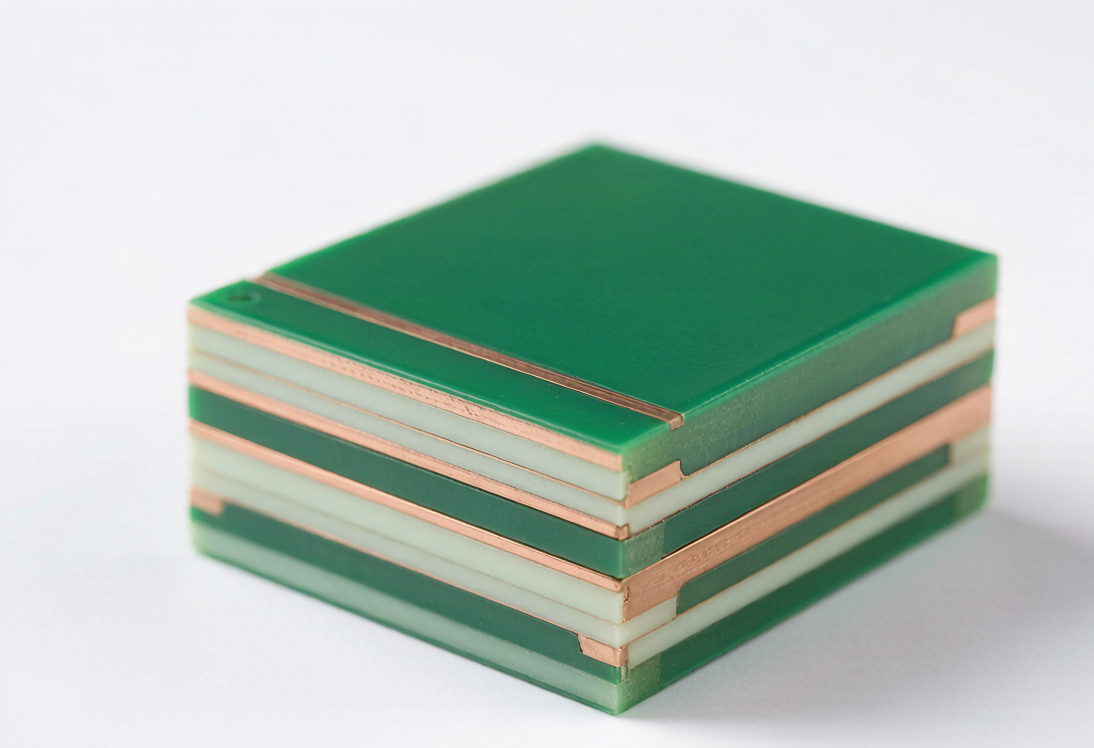
Typical Multilayer PCB Stack-Up
| Layer Component | Function |
|---|---|
| Copper Foil | Electrical circuit transmission |
| FR4 Core | Mechanical support and insulation |
| Prepreg | Bonding adjacent layers |
| Inner Circuit Layers | Signal and power routing |
| Outer Circuit Layers | Component assembly and surface circuitry |
| Press Plates | Provide uniform pressure and heat transfer during lamination |
Why Registration Accuracy Is Critical
Any misalignment between layers can affect the electrical performance and manufacturability of the finished PCB.
Poor registration may result in:
- Inner layer offset
- Via-to-pad misalignment
- Fine-line circuit deviation
- Reduced drilling accuracy
- Impedance inconsistency
- Increased scrap rate
Alignment Challenges
Precise layer registration is highly dependent on stable control of multiple variables throughout the PCB lamination cycle. Unregulated thermal expansion, stacking errors, unstable resin flow and uneven cooling will all trigger alignment defects and compromise dimensional accuracy.
1. Thermal Expansion Differences
Copper foil, FR4 core and prepreg materials feature distinct thermal expansion coefficients. During high-temperature lamination, inconsistent thermal expansion easily shifts inner layer positions before resin fully cures.
Potential Issues: Layer displacement, registration deviation, unstable dimensional performance
2. Stack-Up Positioning Errors
Tiny positioning inaccuracies during manual or automated lay-up will accumulate exponentially with the increase of PCB layers, resulting in amplified structural errors.
Potential Issues: Layer offset, irregular panel geometry, decreased alignment precision
3. Uncontrolled Resin Flow During Pressing
Uneven pressure distribution leads to irregular resin flow in the heating phase. Unbalanced resin movement pushes circuit layers locally, causing subtle displacement across the panel.
4. Cooling-Generated Residual Stress
Potential Issues: Panel warpage, layer drifting, poor dimensional repeatability in mass production
Pressure Distribution
Uniform pressure distribution is one of the most important factors affecting multilayer PCB registration accuracy.
Precision Press Plate Flatness
High-flatness press plates ensure every PCB panel receives consistent contact pressure throughout the press cycle.
Benefits
- Stable stack-up positioning
- Uniform layer compression
- Improved registration consistency
- Better panel flatness
Even Pressure Transmission
High-rigidity press plates minimize elastic deformation under high-pressure lamination, ensuring equal force across the entire panel.
Manufacturing Benefits
- Reduced localized deformation
- Consistent resin flow
- Accurate layer alignment
- Improved dimensional repeatability
Uniform Heat Distribution
Consistent thermal transfer allows all layers to cure simultaneously, minimizing differential expansion between materials.
Advantages
- Controlled resin curing
- Reduced thermal stress
- Better layer registration
- Stable board dimensions
Optimized Cooling Stability
Controlled cooling helps maintain the alignment achieved during pressing by minimizing shrinkage-induced movement.
Results
- Lower residual stress
- Improved geometric stability
- Better drilling precision