
FR4 PCB Press Plates for Dimensional Stability
FR4 PCB press plate meets the strict precision control requirements for FR4 printed circuit board lamination. Properly matched press plates effectively improve thermal stability and interlayer bonding strength, and ensure consistent quality for mass production of multi-layer PCBs.
Key Material Properties
| Property | Influence on Lamination |
|---|---|
| Glass Fiber Reinforcement | Provides mechanical strength and dimensional support |
| Epoxy Resin System | Determines resin flow and curing behavior |
| Coefficient of Thermal Expansion (CTE) | Affects dimensional changes during heating and cooling |
| Glass Transition Temperature (Tg) | Influences thermal stability during lamination |
| Moisture Absorption | May cause expansion and void formation |
| Mechanical Rigidity | Helps maintain panel geometry under pressure |
Why These Properties Matter
During lamination, FR4 PCB press plate expands as temperature increases and contracts during cooling. If thermal expansion and resin curing are not properly controlled, the finished PCB may suffer from dimensional variations, misregistration, or warpage.
FR4 Lamination Challenges
Several factors during the lamination process can negatively affect dimensional stability.
Uneven Pressure Distribution
Localized pressure differences may result in:
- Panel distortion
- Thickness variation
- Resin-rich or resin-starved areas
Thermal Expansion Mismatch
Different expansion rates between copper foil, prepreg, and FR4 core materials can lead to:
- Internal stress
- Layer misalignment
- Registration errors
Resin Flow Variability
Excessive or insufficient resin flow may cause:
- Edge deformation
- Uneven bonding
- Dimensional inconsistency
Cooling-Induced Stress
Improper cooling may generate residual stresses that lead to:
- Reduced drilling accuracy
- Board warpage
- Panel bending
Flatness Control of FR4 PCB press plate
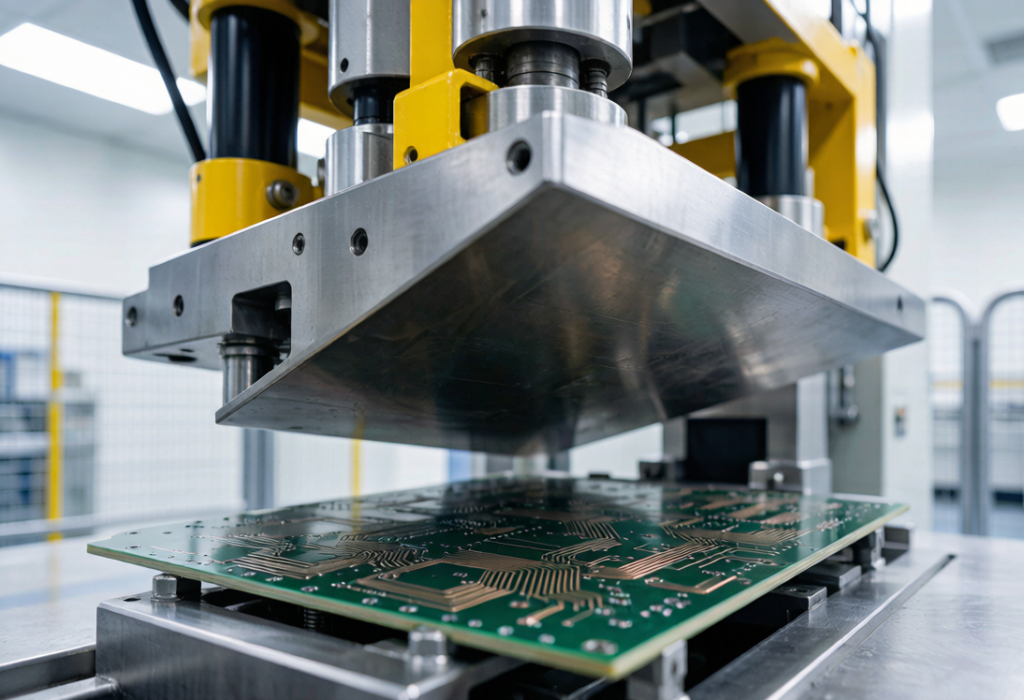
Superior board flatness is a core target of FR4 PCB lamination. Stable flatness, uniform pressure and precise thermal management are essential to achieving high-precision, dimensionally consistent multilayer PCBs.
Precision Press Plate Flatness
High-precision press plates deliver full, even contact across the entire PCB surface, maintaining balanced pressure distribution throughout the entire lamination process.
Key Benefits: Improved overall board flatness, uniform panel thickness, accurate layer alignment, and minimized panel deformation.
Uniform Pressure Distribution
Consistent pressing pressure eliminates localized over-compression and stabilizes resin flow during lamination.
Manufacturing Benefits: Stable panel geometry, reduced thickness deviation, and higher batch-to-batch production consistency.
Controlled Resin Flow
Balanced resin flow avoids localized stress concentration, effectively stabilizing panel structure and maintaining precise dimensional accuracy.
Optimized Thermal Stability
Reliable thermal management is critical for precise PCB lamination. Precision press plates ensure even heat transfer across the entire material stack.
Thermal Performance Benefits: Uniform resin curing, stable thermal expansion, lower internal stress, and excellent dimensional repeatability.
Precision Heating & Cooling Control
A gradual, optimized heating profile reduces thermal shock and enables steady resin flow before curing. Matched controlled cooling processes relieve shrinkage stress and lock in stable panel geometry after pressing.
Process Benefits: Greatly reduced board warpage, sustained flatness stability, higher drilling precision, and improved overall dimensional consistency for mass production.
Quality Improvement
Optimizing the FR4 lamination process with high-performance press plates delivers measurable quality improvements.
| Quality Indicator | Improvement |
|---|---|
| Dimensional Accuracy | Higher consistency |
| Board Flatness | Improved |
| Thickness Uniformity | More consistent |
| Layer Registration | Enhanced |
| Warpage | Reduced |
| Drilling Accuracy | Improved |
| Process Stability | Increased |
| Production Yield | Higher |
Recommended Press Plate Characteristics
For FR4 PCB lamination requiring excellent dimensional stability, press plates should provide:
| Characteristic | Benefit |
|---|---|
| High Flatness | Uniform pressure distribution |
| Excellent Thermal Conductivity | Stable heat transfer |
| High Rigidity | Minimal deformation |
| High Surface Quality | Improved resin flow |
| Stable Hardness | Long service life |
| Excellent Wear Resistance | Consistent performance over repeated cycles |
Expected Results
By combining optimized process parameters with precision-engineered press plates, manufacturers can achieve:
- Excellent dimensional stability
- Superior board flatness
- Accurate layer registration
- Consistent panel geometry
- Reduced warpage
- Higher production yield
- Lower manufacturing costs
- Reliable performance in high-volume PCB production
FAQ
- Why is dimensional stability critical in FR4 PCB lamination?
Dimensional stability ensures accurate layer registration, drilling precision, and reliable electrical performance, particularly in multilayer and HDI PCB manufacturing.
- How do press plates improve board flatness?
Precision press plates distribute pressure evenly and maintain surface flatness throughout the lamination cycle, minimizing deformation and thickness variation.
- What causes warpage in FR4 PCBs?
Warpage is typically caused by uneven thermal expansion, residual stress, inconsistent pressure distribution, or improper cooling during lamination.
- Which press plate properties are most important?
The most important characteristics include high flatness, excellent thermal conductivity, high rigidity, and consistent hardness to ensure stable lamination performance.