
Press Plates for Compact HPL Manufacturing
Compact HPL Press Plate is engineered for compact HPL production featuring stacked multi-layer kraft paper and stringent lamination conditions. This guide covers core process requirements and how the specialized plates enhance dimensional stability, curing uniformity and finished product durability.
Compact HPL Production Process Overview
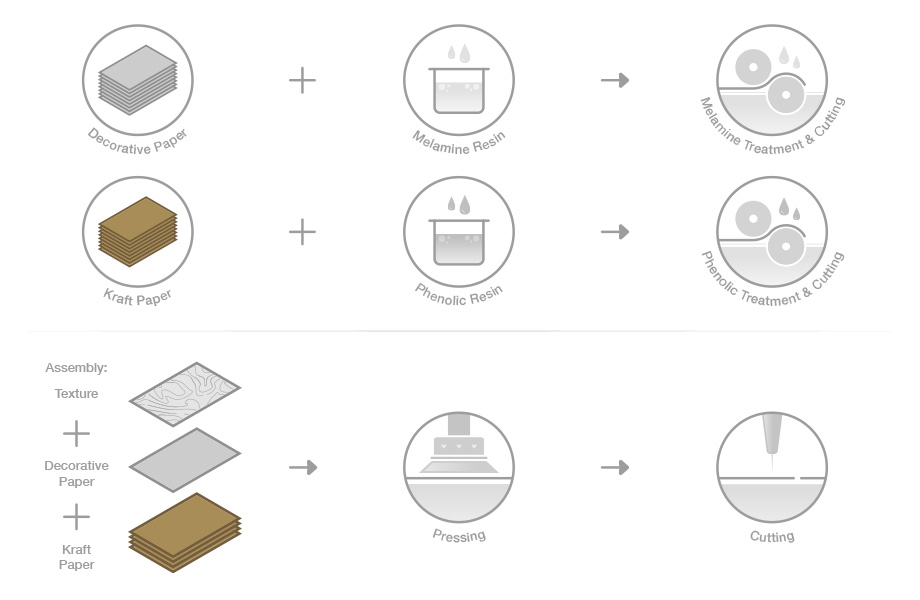
Compact HPL is produced by stacking multiple layers of phenolic resin-impregnated kraft paper, with decorative surface papers added when required. The assembled stack is then consolidated under high temperature and high pressure into a solid laminate.
Typical production stages include:
- Kraft paper preparation
- Resin impregnation
- Layer stacking
- High-pressure hot pressing
- Cooling under controlled pressure
- Cutting and finishing
Compared with standard decorative laminates, Compact HPL requires substantially higher pressing forces and longer consolidation cycles to achieve full structural density.
Why Pressure Distribution Is Critical
During compact laminate production, pressure must be transmitted uniformly through every layer of the laminate stack.
Uneven pressure distribution can result in inconsistent consolidation, localized stress, and variations in panel density that directly affect mechanical performance.
Uniform pressure helps manufacturers achieve:
- Consistent panel density
- Stable internal bonding
- Uniform thickness
- Reliable mechanical strength
- Long-term dimensional stability
As laminate thickness increases, maintaining balanced pressure across the entire pressing area becomes increasingly important.
Common Pressure Distribution Challenges
High-pressure production environments present several process challenges that can reduce laminate consistency and increase production defects.
| Manufacturing Challenge | Production Impact |
|---|---|
| Uneven pressure distribution | Density variation across the panel |
| Localized pressure concentration | Internal stress accumulation |
| Inconsistent compression | Thickness variation |
| Edge-to-center pressure imbalance | Uneven structural properties |
| Insufficient consolidation | Reduced mechanical strength |
| Excessive localized pressure | Surface cracking or edge damage |
These issues become more pronounced in thick Compact HPL panels and large-format production.
Root Cause Analysis
Many structural defects originate from pressure transfer rather than the resin formulation itself.
Uneven Pressure Transmission
If pressure is not evenly distributed, different regions of the laminate experience different compression levels, resulting in inconsistent density.
- Press Plate Deformation
Insufficient plate rigidity may cause slight deformation under high pressing loads, reducing pressure uniformity.
- Stack Compression Imbalance
Variations in compression throughout the laminate stack affect internal bonding and final panel stability.
Pressure Loss During Long Press Cycles
Continuous high-pressure operation can gradually reduce pressure consistency if the press plate lacks adequate structural stability.
Pressure Distribution Optimization
Precision-engineered press plates help maintain stable pressure throughout the entire pressing cycle.
- High Rigidity
High structural stiffness minimizes plate deformation under heavy loads and supports consistent pressure transmission.
- Uniform Pressure Distribution
Even pressure across the complete laminate surface improves consolidation and reduces localized stress.
- Stable Compression Control
Balanced compression helps produce panels with consistent density and reliable structural properties.
- Excellent Flatness
Precision flatness minimizes pressure concentration while improving thickness consistency across the panel.
- Long-Term Structural Stability
Press plates designed for continuous high-pressure operation maintain performance over repeated production cycles.
Structural Performance Improvements
Optimized press plates help manufacturers achieve measurable improvements in decorative surface quality.
| Performance Indicator | Conventional Press Plate | Optimized Press Plate |
|---|---|---|
| Panel Density Uniformity | Standard | Improved by 20–35% |
| Thickness Consistency | ±0.15–0.20 mm | ±0.05–0.10 mm |
| Internal Bonding Consistency | Medium | High |
| Internal Stress | Higher | Reduced by 25–40% |
| Edge Quality | Standard | Improved |
| Mechanical Strength Consistency | Medium | Excellent |
| First-Pass Production Yield | 94–96% | 98–99% |
Performance improvements shown represent typical industry results. Actual values depend on laminate thickness, press capacity, resin formulation, production conditions, and process parameters.
Recommended Press Plate Characteristics
| Press Plate Characteristic | Manufacturing Benefit |
|---|---|
| Mirror-polished surface | Superior gloss and clarity |
| Precision surface finishing | Accurate texture reproduction |
| Uniform heat transfer | Stable resin curing |
| High flatness | Consistent pressure distribution |
| Excellent wear resistance | Long-term surface consistency |
| Stable dimensional accuracy | Repeatable decorative quality |